Publicité

Publicité
Le nouveau roman de de Monak à lire absolument

vendredi 16 mai 2014

The Gambier Islands

 
Fourteen islands in one lagoon

Some 1,700 km from Tahiti, the Gambier Islands, an atoll with 14 high islands in the same lagoon, is a unique geological formation in French Polynesia. Although administratively attached to Tuamotu Archipelago, The Gambier are indeed a separate entity.

Lagoon of Rikitea seen from the summit of Mount Duff
All other Polynesian atolls are compound by a belt of land and corals which forms  a “motu” (reef islets) scattered around the lagoon with sometimes, as in Bora Bora and Huahine, a high island in the lagoon… One another exception to this rule: the two islands of Raiatea and Taha’a (Society Islands), surrounded by the same reef.

The Gambier: 14 islands in one lagoon
Another feature of The Gambier: they have the oldest permanent building of Polynesia. These are religious edifices. They were built by missionaries thanks to the indigenous arms. The best known of these buildings is St. Michael’s Cathedral of Rikitea.

 The last specificity of Gambier is the largest and most famous Polynesian pearl Center, both for the importance and the quality of its production.

The Gambier and history
In the twelfth century the settlement of the Gambier Islands began probably by Marquesas seafarers. It was only much later, in 1687, the English pirate Edward Davis wrote in this logbook he had seen islands: may be The Gambier.

Hundred and ten years later, May 24, 1797, the British sailor James Wilson officially discovered them. Some missionaries traveling to Tahiti on board, he gave the Archipelago the name of Admiral Gambier, a guarantor of the activities of the mission. Furthermore, he baptizes the culmination of these islands (441 meters) the name of his ship: Duff.

It must wait, however, until 1826, to see the first European to set foot on one of these islands: the British officer Frederick Beechey.

He makes the first contact with the Mangarevan people.

The Mangarevans of the early nineteenth century
At that time, the population is about 5,000 souls. These Polynesians have their own language: the mangarevan. Some say they would present the characteristic to be vegetarians, but this statement is in no way verified.

Maputea, the king of the time, lives Rikitea, the main village on the island of Mangareva. The population is distributed on the four main islands of the atoll: Mangareva, Akamaru, Aukena and Taravai.

Gregorio Maputeoa, the last king of Gambier
These are the tales of Beechey about his discovery which make the Gambier Archipelago known.  Its geographical location makes it a quick stopover significant resupplying of many merchant ships.

Already, the particular quality of the oysters that inhabit the lagoon and their abundance allow rapid intense commercial activity development.

The evangelization of Gambier
In 1834, the Congregation of the Sacred hearts (Picpus Brothers) creates, on the deserted island of Akamaru, the first Catholic mission in the South pacific. This is where evangelism really starts throughout Polynesia.

Between 1834 and 1871, when father Laval was forced into exile in Tahiti, the Picpus Brothers erected many buildings for religious purposes.

Our Lady of Peace on the island of Mangareva
The oldest of them is located on the island of Aukena. This is the church of Saint-Raphaël which was erected in 1839. This is the first church built in permanent structure in French Polynesia.

In the same period are also built an imposing cathedral, nine chapels, watchtowers, a prison…

The Gambier and Pearl culturing
If, in the past, four islands of The Gambier were permanently inhabited, today the entire population lives on Mangareva. The other islands are used for various activities, but are deserted at night.

Until the early 1960s, the mainstay resources of the islands is based on the trade of pearl, used mainly for the manufacturing of buttons.

Tahiti has a visionary Robert Wan. He created the first pearl farm in the lagoon of mangareva. Today, there are about a hundred!

Village of Rikitea seen from the slopes of Mont Duff
But this development is at the expense of traditional activities. Self-sufficient in 1960, the Gambier today are importing from Tahiti 85% of what they consume. And the collapse of world prices of the pearl doesn’t help matters.


The tourism in Gambier
There is no hotel in The Gambier. Only a few guesthouses can accommodate tourists.

The other major drawback of the Archipelago lies in its remoteness and in a very limited air service; Air Tahiti provides only two weekly flights.

Yet the Gambier have many arguments to make to develop this activity. In addition to a beautiful lagoon, there is this unique architectural heritage in the world, the extraordinary world of the pearl farmers, and especially a particularly warm and welcoming population.


An article of Julien Gué
Translated from French by Monak


Copyright Julien Gué. Ask for the author’s agreement before any reproduction of the text or the images on Internet or traditional press.


jeudi 8 mai 2014

« Marée acide » de Monak


Un premier roman plus que réussi

De flux en reflux, la musique des mots de Monak fait de ce court roman comme une profonde plongée en mer inconnue.

            Il aura fallu vingt-et-une années pour que s’écoulent les phrases entre le premier mot écrit le 27 août 1977 à Port-Navalo en Bretagne et le point final posé le 27 août 1998 au Cap-Négro en Tunisie.

Et il aura fallu seize années encore pour que Monak, échouée cette fois sur une grève polynésienne, se décide enfin à le publier.

Monak en plein travail à Rangiroa…

            Le choix de l’autoédition via un web-éditeur s’est imposé de lui-même, tout comme pour « Chkakel » paru en juillet 2012. Tout simplement parce qu’il accélère les processus et permet d’éviter les fourches caudines des comités de lecture plus ou moins bien intentionnés à l’égard des auteurs inconnus.

Monak écrivaine
Ne nous trompons pas : Monak n’est pas une novice de l’écritoire. Elle a souventes fois publié des nouvelles et des poèmes. Elle fut même publiée dans une anthologie du « féminin nomade » en 2012 : « Pas d’ici, pas d’ailleurs, Anthologie poétique francophone de voix féminines contemporaines ».

En 1990, Monak danse dans « Les cris Sourdent » de  Sadok ben Chaabane

Titulaire d’un doctorat de lettres modernes (Université de ParisIII-Sorbonne en 1985) avec une thèse aujourd’hui publiée sous le titre « Image, imaginaire, symbole, la relation mythique dans l’œuvre de Le Clézio », Monak a déjà publié trois autres romans, plusieurs ouvrages de poésie, signé de nombreux textes pour le théâtre, collaboré avec plusieurs journaux (en Tunisie)… Etc, etc, etc !

L’autre aspect du parcours de Monak, c’est sur les planches et dans les coulisses des théâtres qu’il faut le chercher. Auteure de spectacles, comédienne et surtout interprète en danse-théâtre, elle a collaboré à de très nombreuses créations durant les vingt années de son séjour en Tunisie. De ce parcours, on retiendra tout particulièrement sa rencontre et sa collaboration avec le chorégraphe Imed Jemâa. Collaboration toujours d’actualité qui lui a permis de se produire en Tunisie bien sûr, mais également ailleurs en Afrique du Nord, au Moyen-Orient, en Afrique noire, en Europe, au Canada…

« Chkakel », l’avant dernier paru
C’est poussée par l’envie d’avancer, de clore des chapitres achevés mais jamais vraiment refermés que notre écrivaine a décidé de publier ses œuvres passées mais encore inédites. La première fut « Chkakel », « Marée acide » est la seconde.

A propos de « Marée acide »
Comme toujours avec les œuvres de fiction de Monak, il est extrêmement difficile de résumer ce roman. Ou devrais-je dire ce rêve-moovie ?

Selon elle, « Marée acide est l’histoire d’une môme en quête de l’autre. (…) Quant à la forme, je me suis demandé ce qui se passerait si un personnage venait à se mêler de l’écriture de sa propre histoire… ».

Et, effectivement, lorsqu’un personnage de roman décide de se mêler de prendre la place de son auteur devant la feuille blanche, il se passe des choses surprenantes.

La couverture du dernier né de Monak
Dans un style beaucoup plus épuré qu’à son habitude, Monak nous entraine dans ces pages au plus profond d’une plongée saisissante dans les zones les moins claires, mais parfois les plus lumineuses, du secret de ses personnages. Débarrassée des contraintes du temps et de la géographie, elle nous perd dans un labyrinthe de sensations et d’idées dont les nœuds se dénouent sans prévenir.

Que voulez-vous que je vous dise ? J’ai adoré ce livre et suis incapable d’en parler de manière cohérente ! Alors, lisez-le… et dites-moi ce que vous en pensez !

PS : pour vous offrir les deux romans de Monak cités dans cet article, rien de plus simple : il vous suffit de suivre les liens ci-dessous et de passer commande. Ils sont tous les deux disponibles en version papier et numérique…
Pour vous procurer « Marée acide », cliquez ici : http://www.thebookedition.com/maree-acide-monak-p-110700.html

Un article de  Julien Gué

Tous droits réservés à Julien Gué. Demandez l’autorisation de l’auteur avant toute utilisation ou reproduction du texte ou des images sur Internet ou dans la presse traditionnelle.

vendredi 2 mai 2014

The Tuamotu Archipelago


The symbol of the dream islands

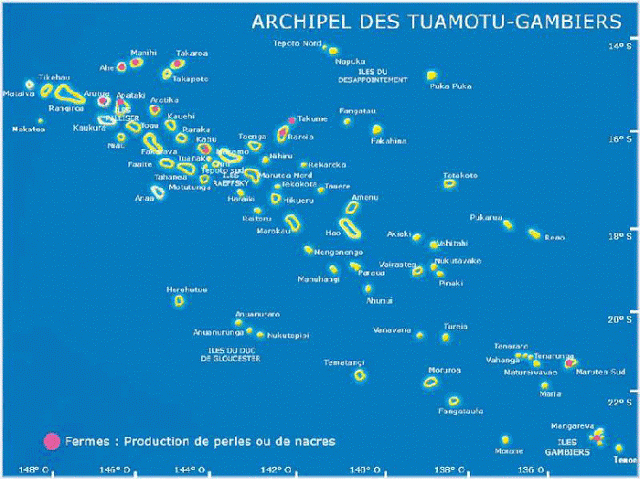
Among the 118 islands of French Polynesia, 78 are atolls and make up the whole Archipelago of the Tuamotu-Gambier.

An atoll is the oldest geological shape of the volcanic islands. It results at the same time, from the formation of a coral reef, surrounding an extinct volcano and combined phenomena of erosion of the volcanic cone and its collapse on itself. So there’s left only a ring of coral enclosing a lagoon left. It may be open or closed depending on whether or not there are passes.

On the other hand, there are Hoa (water passages through the motu) which allow the movement of water during tides. 

Among the 78 islands of The Tuamotu-Gambier, 76 are atolls. The closed Archipelago of Gambier and Makatea Island make an exception to this rule.

The Tuamotu Archipelago: a rosary of pearls…
By the number of its islands, such as by the maritime area occupied, the Tuamotu Archipelago is by far the most important of French Polynesia. 

Cartographic reality of the Tuamotu Archipelago
As a huge barrier between the Society Islands and the Archipelago of the Marquesas, Tuamotu stretch over 1,800km long and 600 wide, from north-east to south-east. They cover an area of 800,000 km2.

In the census of 2007, there were 18,317 inhabitants throughout Tuamotu-Gambier, among which 3,384 on the only Rangiroa Atoll.

From the largest of these atolls, Rangiroa, the lagoon of which (second of the world) could contain the whole island of Tahiti, to the smallest ones that are uninhabited as much as inaccessible, it’s a recognizable pattern: the feeling of being entered a postcard…

In Tuamotu, truth is often stranger than fiction and dream
Lagoons with unforgettable colors lined by white beaches, and protected from the sun by the inescapable coconut palms, seabed incredibly rich in natural resources (animal and plant), bird species, many of which are endemic…

And most importantly, a wonderful people whose only kindness equals simplicity.

History and Tuamotu
The origin of the settlement of the Tuamotu is due, it seems, to relatively recent immigrants from the Marquesas Islands, probably in the sixteenth century and after they would have been made livable by the introduction of coconut.

Until 1854, the archipelago is named Pomotu, which means “Subservient Islands”. At that date, the French government changed it to Toamotu (“Distant Islands”) and became Tuamotu.

Now known by sailors as the archipelago of “Low Islands”, it has been also called for a long time the “Dangerous Archipelago” or the same as the “Bad Sea”…

It’s on 24 January 1521 that Ferdinand Magellan discovers Puka Puka. It’s about the first atoll of the Pacific Ocean of being unearthed by the Europeans.

A few years later, following the road that lead to Tahiti, Louis Antoine de Bougainville ventures successfully, but not without dismays, into this fantastic maze of islands.

But we must wait nearly three hundred years, on September 6th, 1839, to be precise, before being discovered and focused on the card, the last Paumotu* atoll. It’s the atoll of Ahe, discovered by the explorer and American naval officer Charles Wilkes.

It’s in 1844 that the Tuamotu Archipelago became a French protectorate. Its annexation to the French Republic is official in 1880.

Coconut grove on the Atoll of Rangiroa.
The isolation of atolls, their poverty and especially the danger of their waters and passes allowed them to get somewhere safe in their lagoons and to be protected from the large eddies of human history.

The economy in these atolls of heaven
Life is hard on the Tuamotu atolls: fresh water is very scarce, and there is a need to collect the rain to get something to drink.

The Paumotu people have long lived exclusively from fishing and about of all the wealth of the coconuts, until the French industry is interested by the nacre of oysters of the Tuamotu, which was long the raw material for the manufacture of buttons.

T
he hard work of copra
It’s only in the 1970s that these oysters are raised for their unique-colored pearls. The pearl becomes the main economic resource of the archipelago.

The tourism, meanwhile, develops only on the last twenty years, severely handicapped by the scarcity of regular means of communication. However, the beauty and richness of the dive sites are a particularly popular destination for lovers, and there are more and more diving-clubs, well equipped in a number of atolls like Rangiroa or Tikehau
Ocean side from a range of Tikehau Atoll
A trip to the Tuamotu should be earned, but it always leaves lasting memories. A stay at the Tuamotu is, for many, the journey of a lifetime…


An article of Julien Gué
Translated from French by Monak

*Paumotu, adj.: Everything about Tuamotu Islands


Copyright Julien Gué. Ask for the author’s agreement before any reproduction of the text or the images on Internet or traditional press.